
Applied Marine Acoustics
Applied Marine Acoustics is an online MicroCourse focused on the practical application of underwater sound and marine acoustic monitoring. Designed for environmental professionals, marine resource managers, field technicians, consultants, and project planners, this applied course develops the skills needed to interpret acoustic information and support marine monitoring, environmental assessment, and mitigation planning.
Marine environments are complex, and the way sound behaves underwater can vary significantly from one location to another. Oceanographic, environmental, and geologic conditions can all influence sound transmission, making it important to understand how site-specific conditions affect acoustic monitoring and interpretation.
Building on the foundational concepts introduced in Introduction to Marine Acoustics, this MicroCourse explores how underwater sound behaves in real marine environments and how acoustic information is used to address practical environmental challenges. You’ll examine how marine acoustics supports environmental assessments, marine monitoring programs, mitigation planning, regulatory processes, and ocean stewardship.
Through practical examples and applied exercises, you’ll explore acoustic propagation, transmission loss, sound transmission mapping, hydrophone deployment, equipment selection, signal processing, and acoustic data interpretation. You’ll develop a stronger understanding of how monitoring approaches and acoustic tools are selected and applied based on environmental conditions and project objectives.
The course emphasizes the interpretation and application of marine acoustic information to support defensible environmental decision-making. By connecting acoustic principles with real-world monitoring scenarios, you’ll strengthen your ability to evaluate acoustic data, assess monitoring approaches, and understand the factors that influence underwater sound measurements.
This course is intended for learners who have completed Introduction to Marine Acoustics or who already have a basic understanding of underwater sound and want to develop stronger applied knowledge and practical marine acoustics skills.
NRTG’s MicroCourses provide a flexible and enriching pathway to build your skills and expertise — one focused, practical course at a time. Applied Marine Acoustics delivers focused, practical training in a streamlined online format designed for real-world application.
Format: 2 x 2-hour sessions.
Program Outcomes
- Explain how environmental, oceanographic, and geologic conditions influence underwater sound transmission.
- Interpret sound transmission models, transmission loss calculations, and acoustic mapping outputs used in marine projects.
- Evaluate how monitoring design, hydrophone placement, equipment selection, and data processing affect acoustic results.
- Identify common sources of uncertainty and limitations within marine acoustic assessments.
- Apply acoustic reasoning to support monitoring programs, mitigation planning, environmental assessments, and marine mammal exclusion zones.

This course is approved for 4 Continuing Education Credits (CECs) under the Society for Ecological Restoration’s (SER) Certified Ecological Restoration Practitioner (CERP) Program. Participants are responsible for uploading their certificates at ser.submittable.com to receive CECs.
Spencer Quimby, BSc. RPBio
Marine Biologist, Independent Consultant
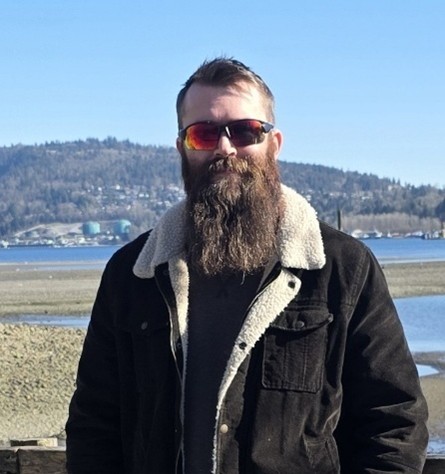
Spencer is a Registered Professional Biologist (R.P.Bio.) with the College of Applied Biology in British Columbia and has a B.Sc. in Marine Biology from Dalhousie University. Spencer grew up in California and has lived and worked in four different provinces in Canada, P.E.I., Nova Scotia, Saskatchewan, and British Columbia. Spencer has worked in fisheries and aquaculture as an aquaculture diver, aquaculture site manager, at-sea fisheries observer, and port supervisor/dockside validator. He branched out into consulting in 2019 and has worked on several major infrastructure projects and many smaller ones in coastal areas of mainland B.C. and Vancouver Island.
Spencer has focused on compliance and verification monitoring for marine and riverine construction projects for the past six years. He provides technical expertise in and has thousands of hours of experience with VHF/UHF SONAR, passive acoustic monitoring equipment, water quality sampling and in-situ monitoring, and marine mammal observation. Spencer has experience providing on-the-job training for technicians and environmental monitors in the principles and applications of SONAR, passive acoustics, and marine mammal observation. He started an independent consultancy in 2024 to further his goals as an environmental professional. He continues to expand his knowledge and experience to better support responsible development and promote compliance with environmental regulations and best practices. Spencer greatly enjoys sharing what he has learned over his career with others who are passionate about these subjects and loves helping people reach their professional and personal goals.