
Marine Mammal Observation
NRTG’s MicroCourses offer a dynamic training pathway that’s as flexible as it is enriching to build expertise. Our Marine Mammal Observation MicroCourse, spanning four hours, delivers interactive and in-depth training in an easily digestible format. It’s designed to maximize your skills for immediate field application.
Dive into the world of marine mammal observation with this comprehensive practical course designed for environmental professionals, land guardians, and anyone passionate about marine life! Whether you’re working on marine development projects, protecting food, social, or ceremonial resources, or simply curious about seals, sea lions, dolphins, and whales, this course equips you with the essential tools to be an effective observer and guardian of marine mammals.
Through engaging exercises, directed discussions, and real-world examples, you’ll master important field skills to minimize the impact of maritime operations on marine mammals. You’ll learn standardized observation techniques, fatigue prevention strategies, and best practices for estimating distances, recording, and communicating observations.
What You’ll Learn:
- Observation Equipment & Field Preparation: Select and use high-quality binoculars, thermal imaging devices, GPS units, and range finders. Prepare for fieldwork with redundancy, comfort, and safety in mind.
- Standardized Observation Techniques: Apply scanning patterns, use proxy indicators (such as birds and fish), and coordinate with multiple observers to maximize detection and coverage.
- Estimating Range & Bearings: Master methods for accurate distance and bearing estimation—including milliradian charts, laser range finders, and triangulation—using practical trigonometry for mapping sightings.
- Fatigue Prevention: Implement strategies to maintain focus and reduce eye strain during long observation shifts.
- Data Quality & Communication: Record clear, concise, and real-time field notes; identify essential vs. optional observations; communicate effectively via radio and digital platforms; and ensure high-quality data for stakeholder confidence.
- Identification Skills: Recognize the three main classes of marine mammals (cetaceans, pinnipeds, fissipeds) and apply practical ID features for compliance and reporting.
- Interdisciplinary Awareness: Understand how marine mammal observation intersects with marine biology, acoustics, oceanography, engineering, law, data science, ethics, and climate change.
- Teamwork & Indigenous Knowledge: Collaborate with peers and local experts, integrating traditional and community knowledge for richer, context-driven data.
Whether you’re an environmental professional, a land guardian, or a passionate advocate for marine life, this MicroCourse will empower you to minimize impacts, contribute to conservation, and confidently observe and report on marine mammals in any setting.
Course Duration: 4 hours
Program Outcomes
Upon successful completion of this program, you will be able to:
- Identify and select appropriate marine mammal observation equipment based on field conditions and project goals.
- Explain how standardized scanning methods support systematic marine mammal observations.
- Estimate distance and bearing to marine mammals using field methods such as range finders, milliradian charts, or triangulation.
- Identify data quality indicators and QA/QC red flags and explain how local or Indigenous knowledge can provide context for observations.
- Describe how marine mammal observation informs related disciplines such as acoustics, oceanography, law, politics, and climate science.

This course is approved for 4 Continuing Education Credits (CECs) under the Society for Ecological Restoration’s (SER) Certified Ecological Restoration Practitioner (CERP) Program. Participants are responsible for uploading their certificates at ser.submittable.com to receive CECs.
Spencer Quimby, BSc. RPBio
Marine Biologist, Independent Consultant
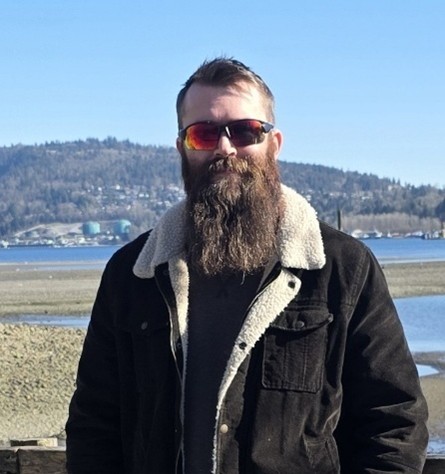
Spencer is a Registered Professional Biologist (R.P.Bio.) with the College of Applied Biology in British Columbia and has a B.Sc. in Marine Biology from Dalhousie University. Spencer grew up in California and has lived and worked in four different provinces in Canada, P.E.I., Nova Scotia, Saskatchewan, and British Columbia. Spencer has worked in fisheries and aquaculture as an aquaculture diver, aquaculture site manager, at-sea fisheries observer, and port supervisor/dockside validator. He branched out into consulting in 2019 and has worked on several major infrastructure projects and many smaller ones in coastal areas of mainland B.C. and Vancouver Island.
Spencer has focused on compliance and verification monitoring for marine and riverine construction projects for the past six years. He provides technical expertise in and has thousands of hours of experience with VHF/UHF SONAR, passive acoustic monitoring equipment, water quality sampling and in-situ monitoring, and marine mammal observation. Spencer has experience providing on-the-job training for technicians and environmental monitors in the principles and applications of SONAR, passive acoustics, and marine mammal observation. He started an independent consultancy in 2024 to further his goals as an environmental professional. He continues to expand his knowledge and experience to better support responsible development and promote compliance with environmental regulations and best practices. Spencer greatly enjoys sharing what he has learned over his career with others who are passionate about these subjects and loves helping people reach their professional and personal goals.