
Restoration Is Not Landscaping: The Field Fundamentals That Separate Good Intentions from Lasting Outcomes
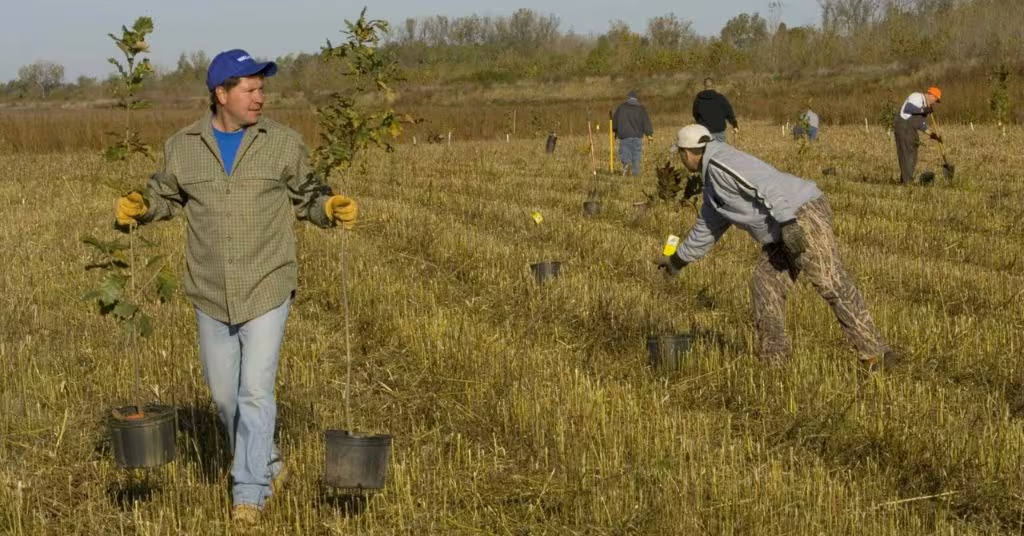
Ecological restoration is often misunderstood.
To an outside observer, it can look like landscaping: plant some vegetation, stabilize a bank, maybe add structure to a stream, and move on. But anyone who has worked in restoration knows that this surface-level view is exactly how well-intentioned projects fail.
The presentation or landscaping of a site when the work crew leaves does not necessarily indicate how successful the project has been. Successful restoration will ensure ecological functions continue to return for years after the project is ‘complete’.
At NRTG, this distinction is why we built the Habitat Restoration Technician Program the way we did — starting with Foundations of Ecological Restoration. Not because foundations are easy, but because they are what separates projects that appear successful from those that actually are.
Note, if you are taking the entire Habitat Restoration Technician Program, your first week of learning will be the ‘Foundations’ referred to throughout this article.
When Restoration Fails, It’s Rarely Because People Didn’t Care
Most failed restoration projects don’t fail due to a lack of effort, funding, or good intentions. They fail because fundamental questions were never fully answered:
- What problem are we trying to solve?
- What factors are limiting recovery at this site?
- What does success look like here — ecologically, culturally, and socially?
- How will we know if the project is working?
NRTG’s experienced instructors have described seeing this pattern repeatedly in the field: projects that were technically “completed” but never functioned as intended. Structures were installed, plants went in the ground, reports were filed, yet the ecosystem didn’t respond.
The issue wasn’t execution. It was (missing or incomplete) foundations.

Restoration Starts Long Before Anyone Touches the Site
One of the most common misconceptions about restoration is that it begins with tools and techniques. In reality, it begins with assessment and prescription.
During a recent Open House, NRTG instructors distinguished clearly between two types of restoration work that are often conflated:
- Prescription development: understanding site history, diagnosing limiting factors, reviewing what has worked (and failed) before, and setting realistic goals.
- Implementation: applying techniques such as in-stream structures, bank stabilization, vegetation restoration, or invasive species control.
These skill sets are complementary but not interchangeable.
Without a sound prescription, even technically excellent implementation can produce poor outcomes. This is why Foundations focuses first on frameworks: assessment → project planning → implementation → monitoring.
This sequence is how experienced practitioners think when standing at a site making real decisions.
“Nothing Replaces Being There” — Even in Online Training
Restoration is deeply contextual. A riffle design that works in one watershed may fail entirely in another. A planting plan that looks perfect on paper can unravel once soil, hydrology, and disturbance regimes are understood.
Our instructors emphasize that while concepts can be introduced in a classroom or online setting, understanding restoration requires learning how to read a site — noticing what is present, what is missing, and what processes are active or broken.
This is why NRTG’s Foundations of Ecological Restoration course is designed around applied learning, even when delivered online. You will not just absorb theory; you are learning how practitioners think, ask questions, and adapt when conditions are imperfect (which they almost always are).

Restoration Is Ethical Work, Not Just Technical Work
Another foundational element that often gets overlooked is ethics.
Restoration decisions are rarely neutral. They involve trade-offs: between species, between timelines, between ecological goals and human pressures. They also involve people, including communities, land stewards, Indigenous Nations, regulators, and funders.
Foundations explicitly addresses this reality by situating restoration within ethical, legal, and cultural contexts, including the integration of Indigenous and Local Ecological Knowledge (LEK) alongside Western science.
During our recent Habitat and Indigenous Open House sessions, instructors spoke about the importance of “Two‑Eyed Seeing” — learning to see from Indigenous and mainstream or ‘Western’ perspectives. When applied to ecological restoration, Two-Eyed Seeing helps ensure sustainable decisions and successful restoration projects that are legitimate, supported, and durable.
Monitoring Is Not an Afterthought — It’s Part of the Work
Monitoring is often treated as optional or secondary. In reality, monitoring is how restoration proves itself.
There is a very close relationship between restoration and environmental monitoring — especially in construction and post‑construction contexts. Understanding why a site is being restored, and what success should look like, directly improves the quality of monitoring and adaptive management.
NRTG’s Habitat Restoration Technician Program introduces monitoring not as a compliance task, but as a continual process — one that informs whether restoration actions are working and what needs to change.
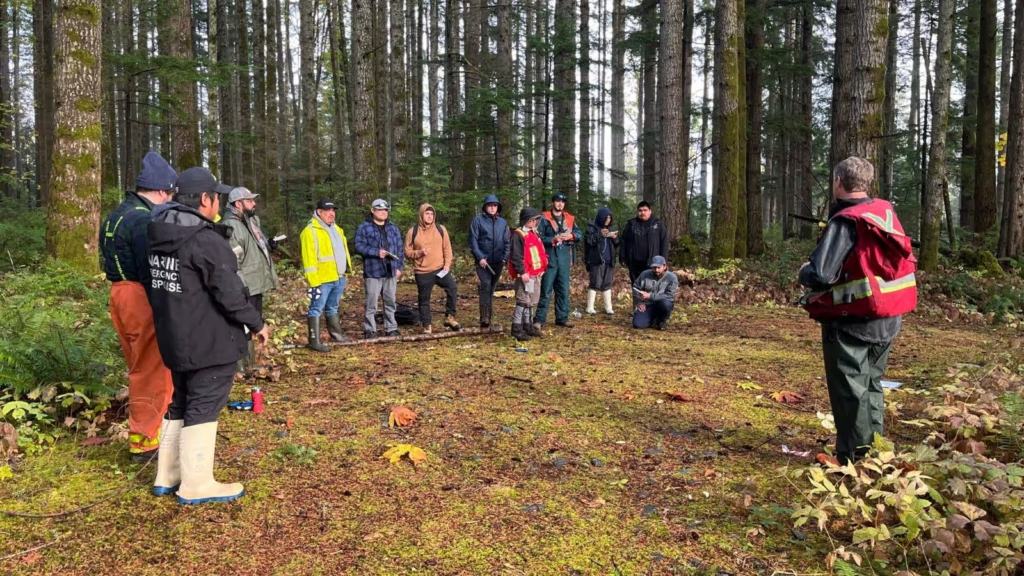
Why We Built this Program
The Habitat Restoration Technician Program was created to address a gap seen again and again in the field: technicians who are skilled, motivated, and hardworking, but who were never given the chance to learn how restoration decisions are actually made.
This course is not about turning you into an instant expert. It’s about giving you the mental models, language, and frameworks used by experienced practitioners so you can:
- understand the intent behind restoration plans,
- make better field-level decisions,
- communicate more effectively with teams and communities,
- and continue learning with confidence.
If you’re new to restoration, Foundations of Ecological Restoration provides a clear starting point. For those already working in the field, it offers a chance to step back, connect the dots, and strengthen how you approach restoration work.
Ecological restoration is complex, humbling work. It demands more than good intentions and technical skills — it demands judgment, context, and an understanding of systems.
That’s why restoration is not landscaping. And that’s why foundations matter.
Interested in learning more?
If you’re interested in building restoration skills that hold up over time, the Habitat Restoration Technician Program — Foundations of Ecological Restoration is offered as a five‑day course this April.
Explore the entire Habitat Restoration Technician Program and see whether it’s the right fit for your work or career path.
Related Blog Posts
10 Years of NRTG: People, Purpose, and Possibility

Tech Meets the Field — Empowering Environmental Work with Grounded Expertise
