From the Ground Up: Empowering Communities Through Training

Imagine your classroom is the forest floor, your blackboard is the sky, and your lessons are carried on the wind and the water. At Natural Resources Training Group, we’ve seen firsthand how powerful learning becomes when it’s rooted in the land and delivered within the community. Over the past 20 years, we’ve provided natural resource training to more than 27,000 students across Canada and not through textbooks alone but through real, hands-on experience.
We once had a student—quiet, reserved—but you could feel his deep commitment to becoming a Land Guardian. Over five weeks, he reconnected with the land in a way that lit something up in him. By the end of the program, he was featured in a National Guardian Network video. Today, he’s the Guardian Supervisor for his Nation. His journey reminds us: when learning happens on the land and within community, it doesn’t just build skills—it shapes leaders.
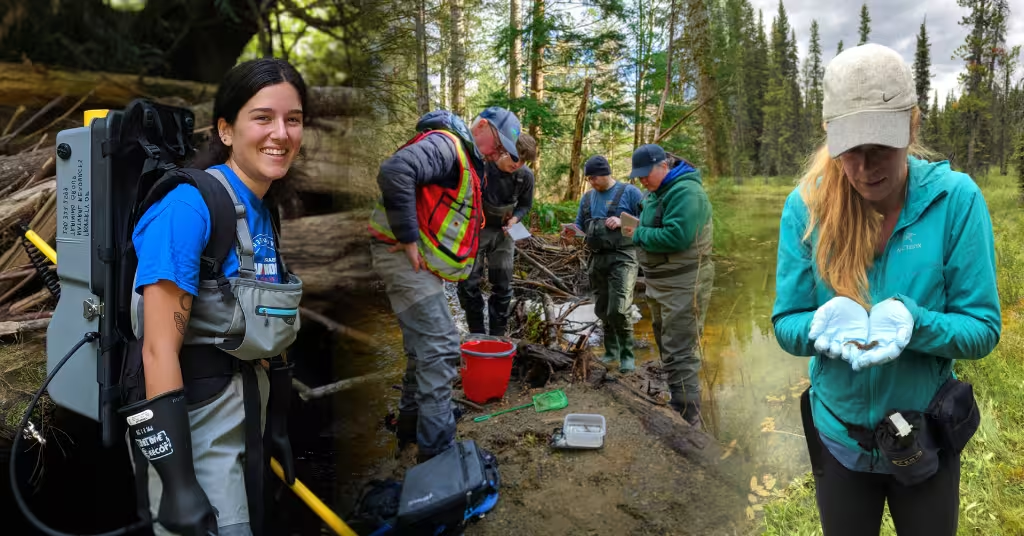
From identifying wildlife habitats to collecting water samples in local streams, our programs are designed to build skills where they matter most: where people live, where culture thrives, and where land teaches.
Here’s why in-community, hands-on training is not only more effective—it’s an investment in your community’s future. By grounding learning within the places and people who know the land best, you’re building local capacity, nurturing leadership, and fostering long-term success. Every skill learned, every connection made, strengthens the roots of communities, empowering them to thrive today and for generations to come.
Learning Happens Best on the Land
Why land-based training matters:
Natural resource work happens on the land—so that’s where effective training belongs.
How students learn best:
Being outdoors engages all the senses, making lessons more immersive, memorable, and meaningful.
What our courses offer:
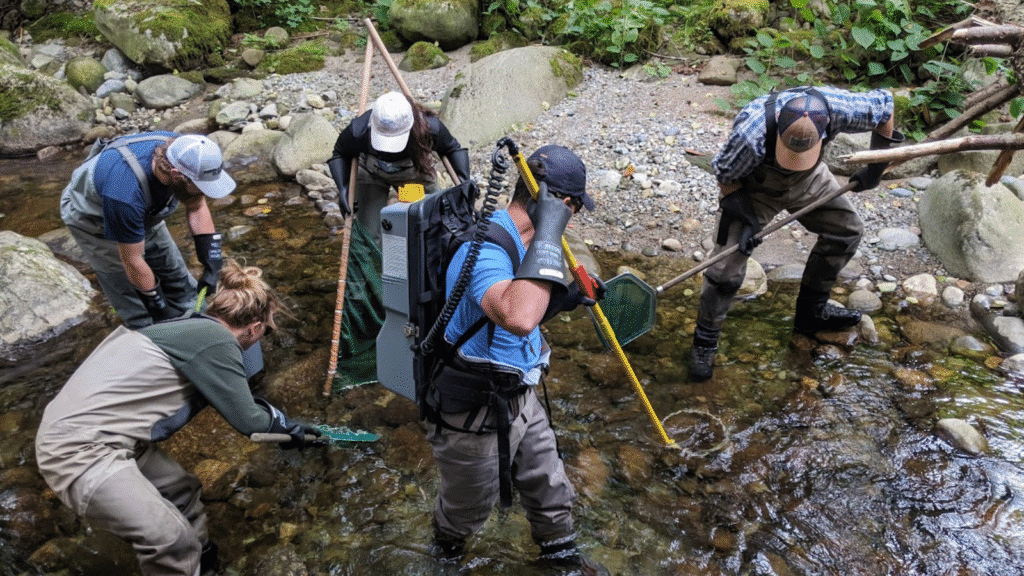
Real-world, hands-on experience where students:
- Identify wildlife habitat: tracking elk through the first snow fall, claw marks etched deep into a cedar trunk left by a black bear’s visit, or fresh beaver gnaw marks on alder stumps that line the riverbank with their lodge just visible upstream.
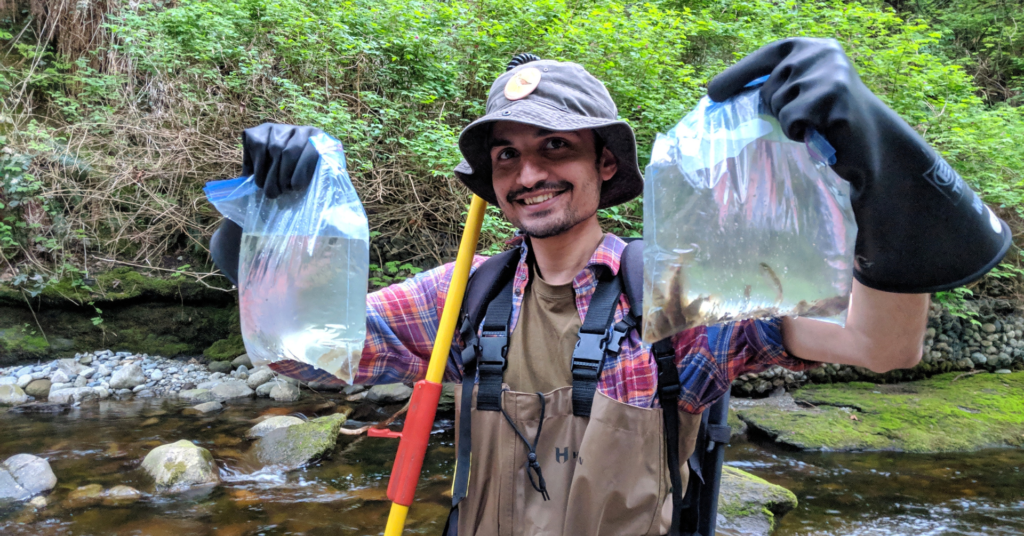
- Collect and interpret field data: conduct regular surveys along a migration corridor to count and track caribou herds, sample water at various depths in a lake to test for pollutants and measure pH, temperature, and dissolved oxygen, or survey a forested area to identify and map the spread of invasive plants like Japanese knotweed.
- Navigate diverse terrain: like the dense coniferous Boreal forests in Northern Ontario where the marshy areas require careful route planning to avoid getting stuck, the Alpine Meadows in the Rocky Mountains where the altitude is high and it is important to avoid damaging the sensitive habitats, or the wetlands and muskeg in Manitoba where sinkholes and hidden water pools sit unnoticed.
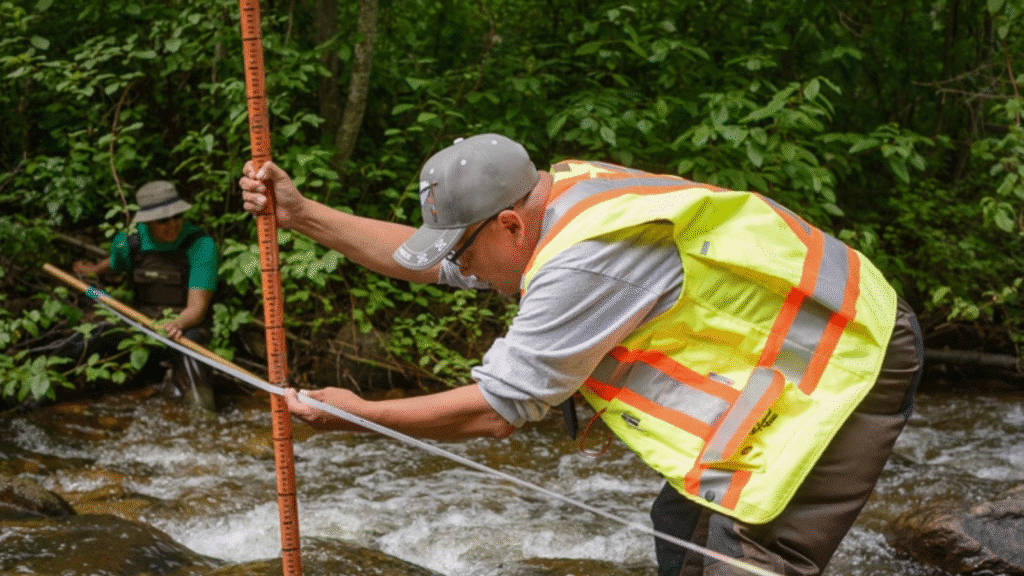
- Operate industry-relevant equipment: like GPS units and handheld mapping devices, water quality testing meters, electrofishing backpack and gear, and tree calipers and diameter tapes.
What the research says:
Experiential learning improves:
- Knowledge retention
- Critical thinking and problem-solving
- Student engagement, particularly in environmental studies
The result:
Students leave with not just stronger technical skills, but also the confidence to work effectively in the field—because their training mirrors the realities of the job.
In-Community Delivery Builds Local Capacity
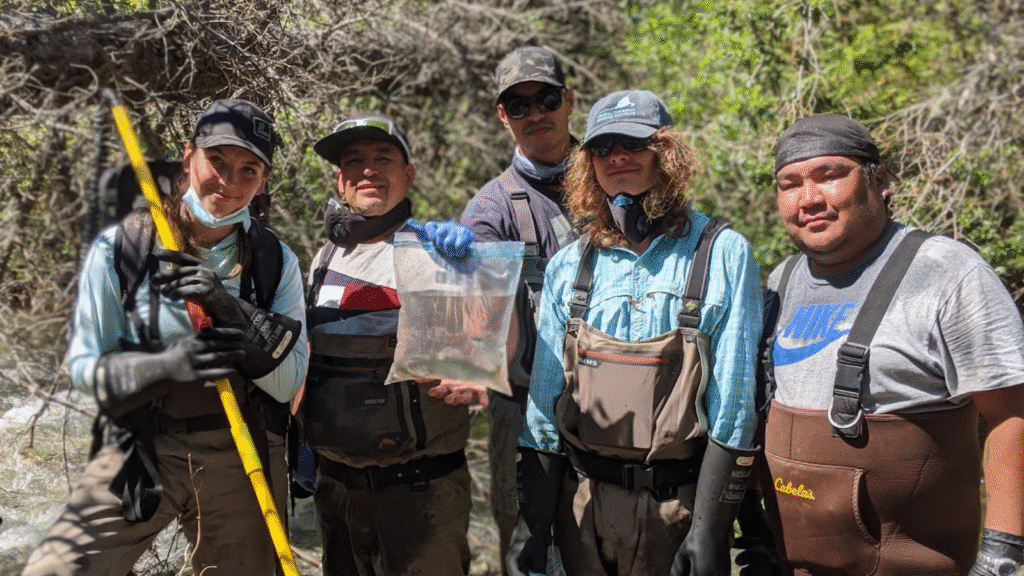
Bringing training directly into communities removes major barriers from travel costs and time away from family, to the stress of unfamiliar environments which are often cited as significant challenges for rural and Indigenous students (Sage Journals, 2021). It also fosters a sense of ownership and relevance. Community members are learning in their own territory about their own ecosystems and resources.
This approach allows us to tailor each program to local conditions, priorities, and knowledge, making it more meaningful and immediately applicable.
We Honour Indigenous Knowledge Systems
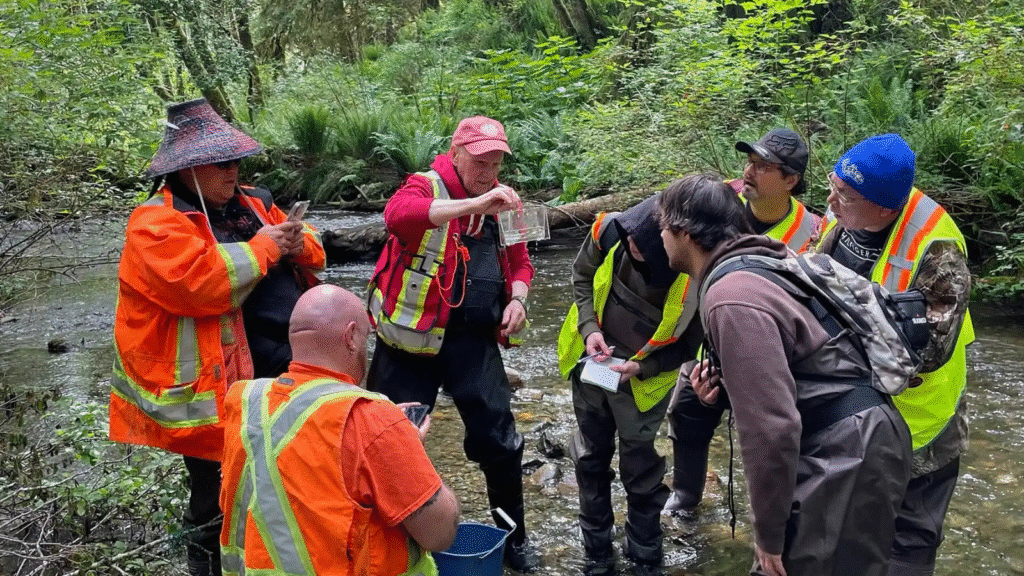
Hands-on training in Indigenous communities creates space for traditional knowledge to meet Western science. Our instructors recognize and respect the deep ecological understanding that exists in every Indigenous Nation. When training happens in community, Elders and Knowledge Keepers can be involved, adding cultural context and wisdom that enriches the learning experience.
This strengthens the connection between students and the land, while promoting two-eyed seeing. A concept developed by Mi’kmaq Elder Albert Marshall which encourages seeing the world through both Indigenous and Western knowledge systems for the benefit of all. (Bartlett, Marshall, & Marshall, 2007).
Training for Real Jobs, Right Away
Our programs are designed with a clear goal: employment. We work closely with industry and community partners to ensure our training aligns with local job opportunities. Because our courses are field-focused, students graduate with job-ready skills they’ve already practiced in real settings.
A 2025 labour market forecast by the Government of Canada explains how fostering skill development will be key to meet current and future labour market needs. In addition, youth not in employment, education or training remain a significant untapped and under-developed source of labour. Reducing barriers for these groups could help expand Canada’s workforce in the face of current challenges. (Government of Canada, 2025). That means in a single community, five new trained monitors could be the difference between proactive stewardship and crisis response.
In parallel, according to Clean Energy Canada (CEC), the number of people employed in green jobs exceeded 430,000 in 2020. Furthermore, the CEC forecasts that by 2030, the number of people employed in environmental protection and sustainability roles will increase by nearly 50% compared to 2020, with jobs in the sector expected to grow by 3.4% annually—almost four times faster than the Canadian average. (Forbes, 2023).
In-community training also gives local employers a direct connection to new talent. It’s a cycle that supports economic development and long-term stewardship.
Confidence Through Competence
We often hear from students who doubted their abilities before training – but something shifts when they’re out in the field. Studies show that hands-on, community-based learning can increase student confidence by up to 50% (Johnson et al., 2020). The moment they flag a fish habitat correctly, set a trap, or complete a water quality test on their own, confidence takes root.
In-community training gives space for students to grow in familiar surroundings, with support from their peers, family, and local mentors. That confidence goes a long way – not just in their careers but in life.
Training That Respects Community Rhythms
Each community is unique, and so are their seasonal cycles, cultural protocols, and community priorities. We work in partnership with local leadership to build training that respects these rhythms.
Whether it’s scheduling around fishing season or incorporating ceremony into the course, our flexibility is key to ensuring respectful and relevant education. This isn’t one-size-fits-all – it’s community-first.
“Culturally grounded education leads to higher engagement, stronger outcomes, and supports reconciliation.”
-Truth and Reconciliation Commission of Canada, Call to Action #62
It’s Not Just Where You Learn – It’s How You Learn
At NRTG, we don’t just teach people how to work in natural resources. We help them reconnect with the land, build skills with confidence, and step into leadership roles within their communities.
“One of the great joys of teaching in community is to watch the confidence and engagement of the students increase over the period of a week. As they get to know the instructor, and trust is grown, the questions become deeper, the discussions more nuanced and powerful. These can only come about from time spent together speaking and listening to each other. Relationships are formed and dignity enhanced.” – Sean Mitchell, NRTG Program Manager and Instructor
When training is hands-on and in-community, it does more than educate — it empowers. The land’s call for stewardship is urgent — will you answer? Explore our upcoming courses to act now.
Written by Kristy Callahan from NRTG
Related Blog Posts
Why Accreditation Matters in Environmental and Ecological Restoration Training

Earth Day, Every Day